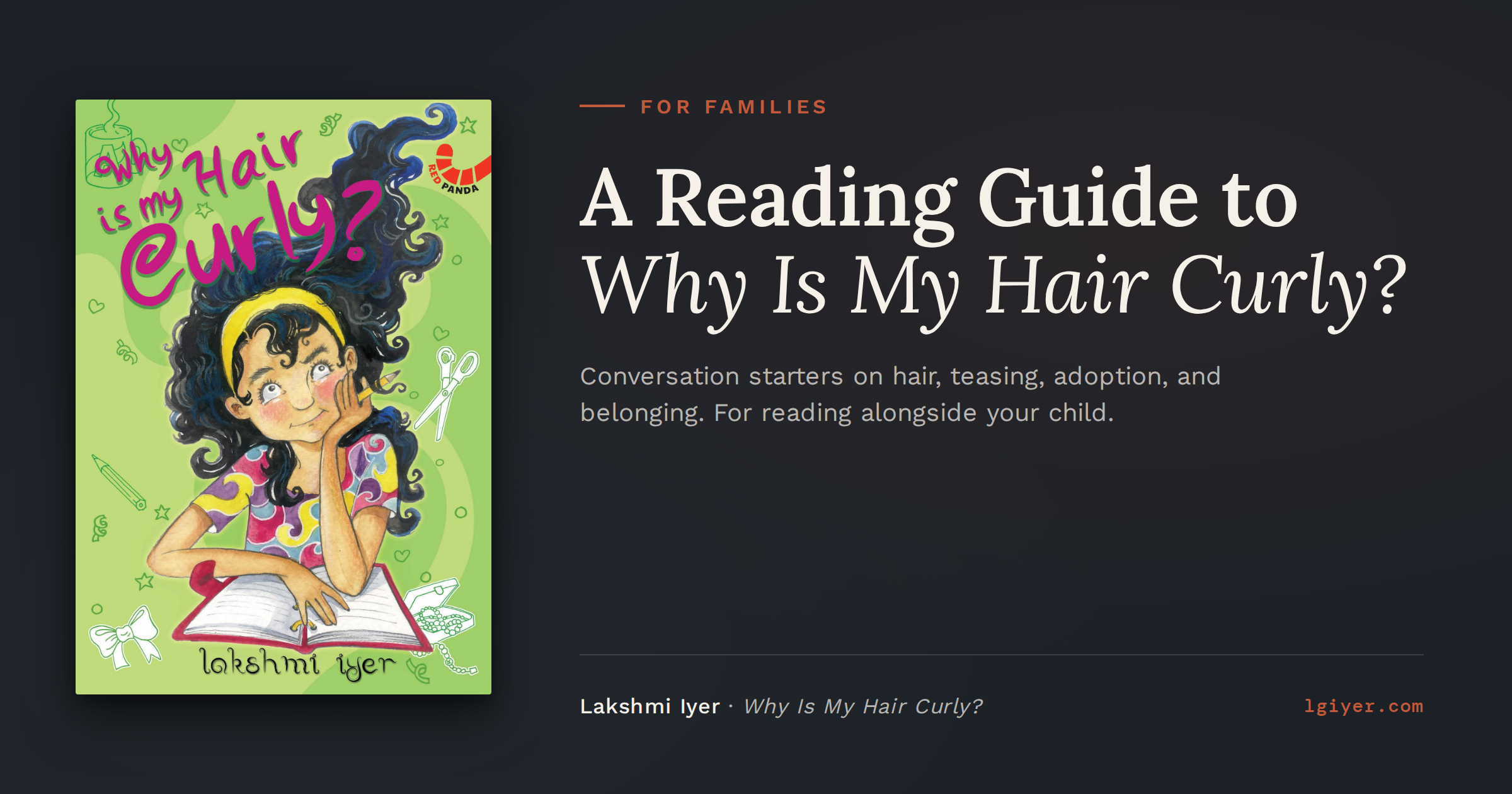
By Lakshmi Iyer · Illustrated by Niloufer Wadia · Red Panda / Westland, 2020
For families reading with children ages 8–11
For the Parent Reading This First
If you’ve picked up Why Is My Hair Curly? for your child, chances are something about Avantika’s story feels close to your family. Maybe your child has curls that have a mind of their own and a family around her whose hair does not. Maybe your family was built through adoption and you are looking for stories that show your kind of family as ordinary. Maybe you are raising a South Asian child in a place where South Asian children are rare on library shelves.
Whatever brought you here, this guide is a quiet companion. It is not a quiz. It is not a lesson plan. It is a set of small things you can do with your child if they want, and nothing you have to do if they don’t.
Children take what they need from stories and leave the rest. Your job is not to extract meaning; it is to be nearby when meaning shows up.
Before You Read
Read the first chapter aloud, or let your child read it to you. Don’t ask any big questions yet. Just notice together:
- Avantika and Avnish are on a train between Coimbatore and Chennai, two cities in South India.
- They live in Chennai with their amma and appa.
- Avantika keeps a journal. Avnish is her younger brother.
- Their cousins tease Avantika about her hair.
If your child is new to Tamil words like paati (grandmother) or chithappa (father’s younger brother), trust the book. The meaning arrives in the sentences around the word. You don’t need to pause and explain.
One thing to know in advance. The book quietly includes a family estrangement storyline. Avantika’s maternal grandmother, who appears later in the book, has been out of their lives for years because she disapproved of her daughter’s marriage. If your child has questions about why families sometimes stop speaking to each other, this thread may raise them. You don’t need to have a ready answer. “That is a real thing that happens in some families, and it is hard,” is enough.
Conversation Starters
Not all at once. Let these land when they want to. Some might never come up. That’s fine too.
About hair
Avantika’s hair is one of the main characters in this book. Somewhere along the way, you could ask:
- “Have you ever wished your hair was different?”
- “Who in our family has hair most like yours? Most different?”
- “If you could change one thing about how your hair is, what would it be?”
If your child has tight curly hair, be gentle with this conversation. Let her lead. If she wants to tell you about a day at school you didn’t know about, don’t fix it right away. Just listen.
About teasing
The cousins call Avantika “Medusa.” A classmate calls her “Saibaba.” She doesn’t tell her parents. You could ask:
- “Has anyone ever called you a name that stuck with you?”
- “What did you do about it?”
- “Did you tell anyone? Why or why not?”
Don’t promise to fix anything. Sometimes children want to tell someone without wanting the someone to act. Wait to be asked before offering solutions.
About adoption (only if this applies to your family, or if your child brings it up)
Avantika and Avnish are adopted. In Chapter 1, Avantika wonders about her birth mother’s hair. The book gives families a natural opening to talk about adoption without making a big production of it.
If you are an adoptive family, this book can be an invitation. If your child has questions, answer them honestly and at the level they are asking. If they ask the same question many times, that is a sign they are still working something out. Ask them what they think. Often they have more answers than we realize.
If you are not an adoptive family, the book is an equally good opening to talk about the different shapes families take. You could ask:
- “What are some different ways families come together?”
- “Do you know anyone whose family was built differently than ours?”
Keep the tone curious, never pitying. Adoption is one ordinary way among many ordinary ways.
About paati and amma
In the last chapter, Avantika’s paati tells her that amma hated cutting her hair as a child but never said so. You could ask your child:
- “Is there something about you that we might not know?”
- “What’s something you wish I understood better?”
Be ready for an answer you didn’t expect. Be ready for no answer at all. Both are okay.
Three Small Things to Try Together
A family hair story
Sit down with old photos, or with elders in your family if they are available by phone. Ask about hair across the generations. Who had curls? Who had it long, who had it cut? Who did the braiding in the mornings? Kids often discover that their own hair tells a story that goes back further than they knew. Paati’s story in the book is a good prompt for this.
A homecoming day
Avantika’s family celebrates her homecoming day each year with rava kesari, a sweet made from cream of wheat, ghee, sugar, and a generous handful of cashews and raisins. Every family has days worth celebrating that aren’t on calendars: the day a child came home from the hospital, the day a family moved, the day a pet arrived, the day a grandparent became a citizen. Pick one. Make a dish. Mark it every year.
A word journal
Avantika keeps a journal. The book is full of Tamil words. Kaapi, murukku, bakshanam, rava kesari. If your family speaks a language other than English at home, your child could keep a notebook of words they love. Words that only exist in that language. Words for foods. Words for relatives.
Books to Read Next
If Why Is My Hair Curly? opened a door for your child, these are good next stops.
If your child loved the hair storyline:
- Hair Love by Matthew A. Cherry. A picture book about a Black father learning to style his daughter’s hair. Short, warm, and a good bedtime book even for older kids.
- I Love My Hair! by Natasha Anastasia Tarpley. A classic. Every girl with textured hair should meet Keyana.
If your child is curious about adoption:
- Bringing Asha Home by Uma Krishnaswami. An older brother waits for his adopted sister to arrive from India. This one is especially good for Indian adoptive families or for siblings waiting for a new family member.
- A Mother for Choco by Keiko Kasza. A picture book with a simple, big-hearted message about what makes a family.
If your child loved the Indian setting:
- Step Up to the Plate, Maria Singh by Uma Krishnaswami. A Sikh-Mexican American girl in 1940s California who wants to play softball. Historical fiction, full of heart.
- Amina’s Voice by Hena Khan. A Pakistani American girl at the start of middle school. For slightly older readers.
- The Night Diary by Veera Hiranandani. A Partition story in the form of a girl’s letters to her mother. For readers ready for a slightly more serious book.
What’s Next
Why Is My Hair Curly? is the first in what is becoming a series. A companion middle grade novel for slightly older readers is forthcoming.
If you’d like to know when it’s out, you can sign up for my newsletter and I’ll let you know. No spam. Just book news, a few times a year.
Thank you for reading with your child. That’s the whole thing, really.
— Lakshmi Iyer
This guide may be shared freely for personal use.